What Drives Value in Sandia Heights View Homes
June 25, 2026
June 25, 2026
A great view can absolutely shape how a home feels, but in Sandia Heights, it can also shape what a home is worth. If you are buying or selling here, you have probably noticed that two homes with similar size can land at very different price points. The reason often comes down to how usable, wide, and protected the view really is. Let’s dive in.
Sandia Heights is not a flat, uniform neighborhood where every lot offers the same outlook. It sits in foothill terrain beside the Sandia Foothills Open Space, an area the City of Albuquerque describes as roughly 2,650 acres with elevations from about 5,720 to 6,800 feet. That terrain creates meaningful differences in sightlines from one property to the next.
In practical terms, your lot position matters. A home perched higher on the foothill slope may capture broader city-light views, mountain views, or both. A nearby home with similar square footage may not, even if it is only a short distance away.
Sandia Heights also has a layer of protection that many other neighborhoods do not. Sandia Heights Homeowners Association materials say many homes back up to National Forest land, and the community covenants are designed to preserve open space, limit building height and vegetation, and protect view corridors. That makes views here more than a nice extra. They are tied to geography and to rules that can help preserve what buyers are paying for.
A view premium is the extra value buyers may place on a home because of its outlook. Research summarized in The Appraisal Journal shows that view premiums are real, but they are not fixed. Some studies found good-view premiums around 8 percent, while others showed different results depending on the view type and the local market.
That is important in Sandia Heights because there is no universal formula. A mountain view does not automatically add the same amount to every house. The market tends to reward a combination of factors, not just the fact that you can see something pretty from one corner of the home.
In this area, the most likely drivers of a premium are:
In other words, buyers usually pay more for a view they can live with every day, not just one they can point to during a showing.
The research report makes one point very clear: quality, scarcity, and permanence matter. That applies directly to Sandia Heights.
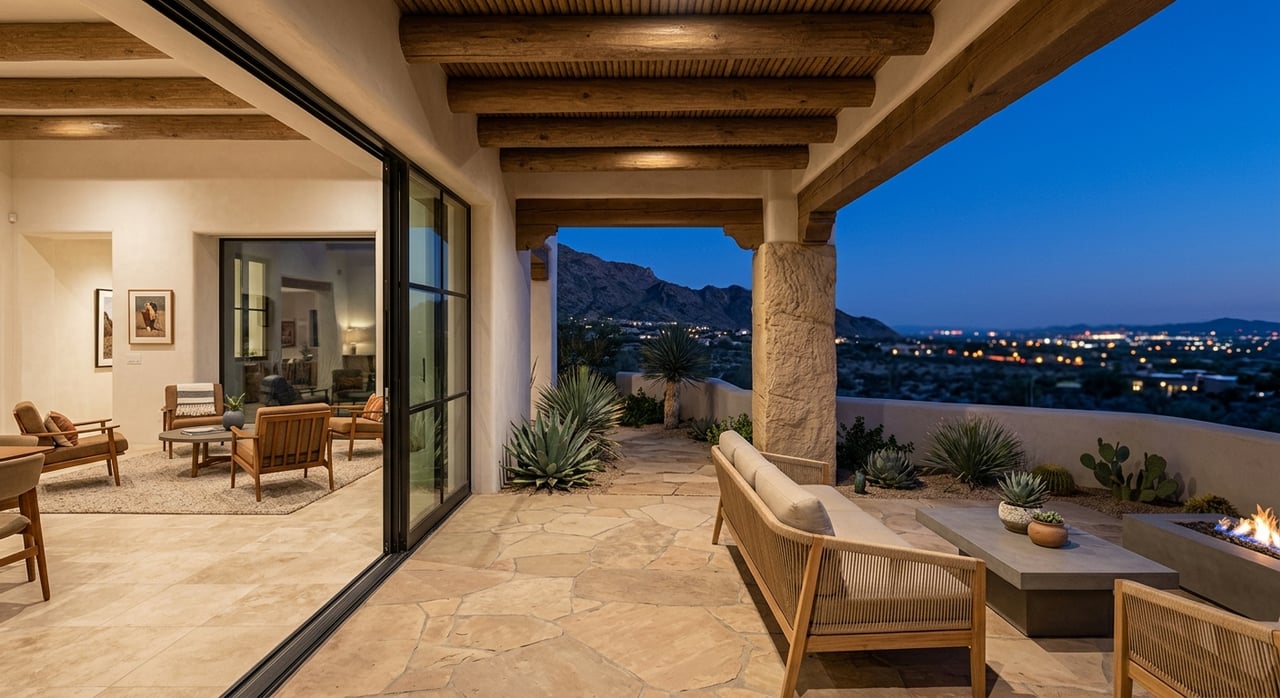
A narrow glimpse from a single bedroom window is different from a broad outlook visible from the kitchen, living room, and primary suite. A nice backdrop from inside is different from a home with decks and patios designed to frame city lights at sunset. And a view that appears stable because of lot position and community restrictions may carry more weight than one that could change with vegetation growth or nearby improvements.
That is why two homes can both be described as having views, yet one commands a stronger price. Buyers are often evaluating the full experience, not just the label.
Recent and current listing examples in Sandia Heights help show how the market talks about views and where buyers may see value.
A sale at 726 Tramway Vista Dr NE Unit 30 involved a 1,764-square-foot home listed at $450,000. Public marketing described breathtaking city and mountain views along with a courtyard and view-oriented lot features. Even at a smaller size, the view was central to the property story.
At the higher end, 13 Sandia Heights Dr NE has been described with city, and mountain views, along with a balcony and spa. 18 Sandia Heights Dr NE highlights deck and patio areas, a landscaped view lot, and a strong emphasis on outdoor enjoyment. 213 Spring Creek Pl NE was marketed around its secluded lot, many windows, city-light views, Sandia views, and entertaining spaces.
There is also a useful counterexample. 34 Sandia Heights Dr NE was marketed with panoramic city views and decks from nearly every bedroom and major living space, yet the listing also said the property needed major work and was cash only. That shows an important truth: a strong view does not erase major condition issues.
It is easy to overestimate what a view can do for value. In reality, the market typically separates view quality from property condition.
If a home needs significant repairs, has outdated systems, or presents poorly, buyers will factor those costs and risks into what they are willing to pay. Even a dramatic outlook may not fully offset the discount tied to condition. That makes pricing especially important for sellers who know their home has both standout scenery and deferred maintenance.
For buyers, this is a reminder to avoid treating the entire price gap between two homes as a pure view premium. Part of that difference may reflect updates, design, lot usability, or repair needs.
If you are buying in Sandia Heights, the safest way to pay for a view is to pay for one that feels durable. That means looking beyond the first impression and asking whether the outlook is likely to remain part of the property’s value story.
A smart buyer checklist includes:
SHHA guidelines say residents are expected to keep vegetation from obstructing views, and exterior changes that affect view corridors or visual character may require approval. That does not mean every view is guaranteed forever, but it does mean buyers should verify what is protected today and what could change later.
If you are selling a Sandia Heights home, view marketing works best when it is specific. General phrases like “great views” are less persuasive than naming exactly what the buyer will experience.
The strongest local listing language tends to identify features such as:
That level of detail helps buyers understand whether the view is part of daily life or just a nice bonus. It also supports stronger photography, better showing flow, and a more accurate pricing conversation.
If vegetation or exterior elements are limiting the outlook, address that before photos and showings when possible. Since SHHA guidelines specifically reference protecting views and managing vegetation, this can be an important part of presentation.
Sandia Heights appears to be a relatively thin-sample market. The research report notes a small number of recent sales and active listings, while Redfin’s neighborhood page showed a median sale price of $1.3 million over the last three months. In a market with fewer transactions, a handful of higher-end sales can influence the apparent premium.
That means pricing a view home here takes judgment. You cannot rely on one percentage rule or one sale around the corner. Instead, you need to compare lot position, view breadth, room orientation, outdoor usability, condition, and the degree to which the sightline feels protected.
This is where a strategic approach matters. The goal is not simply to label a property as a view home. It is to understand how the market is likely to value this view, on this lot, in this condition, at this moment.
In Sandia Heights, views often carry real value because they are tied to topography, scarcity, and community design rules. But not all views are equal, and not all premiums are the same. Buyers tend to pay more for views that are broad, usable, and likely to last.
If you are buying, focus on permanence and daily enjoyment. If you are selling, document exactly how the view lives within the home and price it with both confidence and realism. For tailored guidance on buying or selling in Sandia Heights, connect with D'Nette Wood.
Stay up to date on the latest real estate trends.




Whether you’re buying your dream home or selling for the best value, I’ll be right by your side—offering clear guidance, honest advice, and hands-on support from start to finish.